Checking Access…
Unlock this activity and turn family time into progress, stories, points, and real rewards your child can celebrate.
- Complete guided activities together
- Earn points toward real rewards
- Unlock new books and adventures

 Category
Early Learning & School Readiness
Category
Early Learning & School Readiness
 Age Range
Ages 2–6
Age Range
Ages 2–6
 Time
10–15 minutes
Time
10–15 minutes
 Your Fuzziland Adventure Awaits
Unlock this activity and turn family time into progress, stories, points, and real rewards your child can celebrate.
You can practice circle time with no supplies at all, but a few simple items can help make the routine feel special and familiar.
Subscribe to Fuzzigram to complete this activity, unlock new books, create magical puppet videos, earn points, and redeem real rewards your child will love.
Complete all 7 steps to finish.
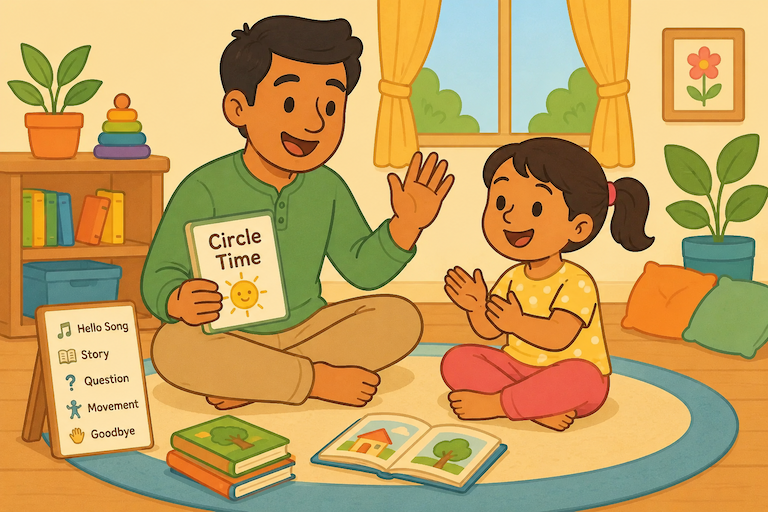
Circle Time Practice gives young children a gentle way to experience the kinds of routines they may see in preschool, daycare, library story time, or kindergarten. Instead of expecting children to suddenly sit, listen, wait, sing, answer, and transition in a group setting, this activity lets them practice those skills at home in a playful, low-pressure way.
During circle time, children learn how to follow a simple sequence: gather together, sing a hello song, listen to a short story, answer a question, move their bodies, and say goodbye. That predictable rhythm helps children feel safe and prepared.
This activity also builds attention, language, self-control, confidence, and social participation. Children practice listening to another person, waiting for their turn, joining a song, copying motions, and responding to simple prompts.
Circle Time Practice strengthens several early school readiness skills at once. It is especially helpful for children who are preparing for group settings.
Parent prompts help children understand the routine without feeling pressured. Keep your voice warm, clear, and encouraging.
Invite a few stuffed animals to sit in the circle. Your child can help them listen, sing, and take turns.
Ask simple daily questions like “What is the weather?” or “How do you feel today?” to build routine language.
Let your child choose between two songs. This builds participation while still keeping the routine structured.
Add more body movement for children who have trouble sitting. Try clap, stomp, jump, freeze, stretch, and breathe.
Pretend your child is the teacher. They can hold the book, call on a stuffed animal, or lead the goodbye song.
This activity works well for ages 2–6. Younger toddlers may only join for a few minutes, while older preschoolers can practice longer routines, questions, songs, and turn-taking.
Yes. Circle Time Practice supports school readiness by helping children practice listening, sitting with a group, following routines, answering questions, waiting, and transitioning between activities.
That is normal. Keep the routine short, add movement, and focus on participation instead of perfect sitting. Circle time can include standing, clapping, stretching, and moving.
Most children do well with 10–15 minutes. For younger toddlers, start with just a few minutes and build slowly as the routine becomes familiar.
Circle Time Practice is a simple school readiness activity for toddlers and preschoolers. Children practice listening, turn-taking, routines, group participation, language, movement, and self-regulation through a short, predictable circle time at home.

Great job completing Circle Time Practice. Your child practiced listening skills, turn-taking, routine awareness, language development, and self-regulation.
View ProgressSomething went wrong. Please try again.
