How to Balance Social Connection and Screen Boundaries
How to Balance Social Connection and Screen Boundaries
Why Screens Complicate Social Connection
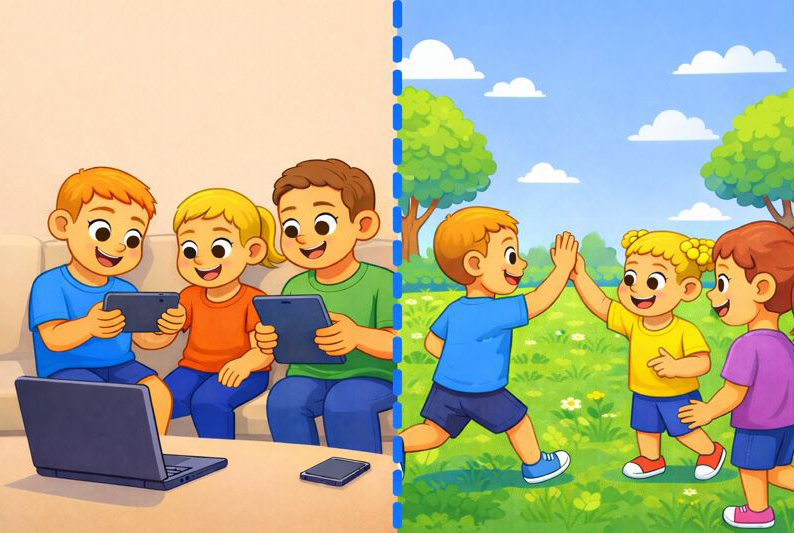
For today’s kids, screens are woven into how friendships form, play happens, and relationships are maintained. Games, shows, and shared digital experiences can be social — but they can also crowd out face-to-face connection when boundaries blur.
Parents often feel caught in the middle. Too many restrictions can isolate kids socially. Too few can leave them overstimulated or disconnected from real-world relationships. The challenge isn’t choosing between connection and boundaries — it’s learning how to support both at the same time.
Healthy balance helps kids stay socially connected without letting screens become the only place that connection lives.


How Screens Support Social Development
Technology isn’t inherently isolating. When used intentionally, it can strengthen social skills and relationships.
Screens can support connection by:
Providing shared experiences
Allowing collaborative play
Supporting communication with peers
Helping kids feel included
These benefits are most powerful when screens complement — rather than replace — in-person interaction.
When Social Screen Use Becomes Too Much
Even socially oriented screen use can tip into overload. Kids may stay engaged long past their emotional or physical limits.
Signs social screen use may need adjustment include:
Difficulty stopping to eat or sleep
Increased irritability after use
Withdrawing from offline play
Feeling anxious about missing out
These signs don’t mean screens are harmful — they signal a need for recalibration.
Separating Connection From Constant Access
Social connection doesn’t require unlimited availability. Kids can stay connected without being constantly reachable.
Helpful boundary distinctions include:
Scheduled vs. open-ended screen time
Planned social play vs. spontaneous scrolling
Checking in vs. staying online continuously
This separation helps kids enjoy connection without pressure.
Teaching Kids That Boundaries Protect Relationships
Boundaries don’t weaken relationships — they protect them. When kids understand this, limits feel less punitive.
Parents can frame boundaries as:
Supporting rest and regulation
Protecting friendships from burnout
Making space for other needs
Supporting Offline Social Skills Alongside Screens
Strong offline skills make digital connection healthier. Kids who feel confident in face-to-face interaction rely less on screens for validation.
Parents can support offline connection by:
Prioritizing unstructured play
Encouraging cooperative activities
Modeling conversation and empathy
These foundations echo Social Skills in a Screened World: Helping Kids Stay Empathic, where balance builds resilience.
Letting Kids Practice Social Choices
Part of learning balance is letting kids experience choice — and natural consequences. This doesn’t mean unlimited freedom, but guided autonomy.
When kids get to choose how and when to connect, they begin to notice what feels good and what feels draining. That awareness supports long-term self-regulation more effectively than constant oversight.
Trust grows when kids feel supported instead of monitored.
Using Routines to Anchor Social Screen Time
Predictable routines reduce social pressure and negotiation. When kids know when connection happens, they’re less likely to cling to screens.
Helpful routines include:
Scheduled gaming or chat windows
Screen-free family times
Clear start and end points
Helping Kids Navigate FOMO Without Overuse
Fear of missing out can drive kids to stay online longer than they want or need. Boundaries help reduce that pressure.
Parents can support kids by:
Normalizing missed moments
Talking about quality vs. quantity of connection
Emphasizing rest and balance
These conversations align with How to Handle Kids’ FOMO Around Devices, where reassurance reduces compulsive checking.
Modeling Balanced Social Tech Use as Parents
Kids learn how to balance connection and boundaries by watching adults do the same.
Helpful modeling includes:
Putting phones down during conversations
Ending digital interactions intentionally
Valuing in-person connection openly
This modeling shows kids that connection doesn’t require constant availability.
Raising Kids Who Value Connection in Many Forms
The goal isn’t to limit social connection — it’s to expand it. Screens are one way kids connect, but they’re not the only way, and they shouldn’t be the most exhausting one.
Families who balance social connection and boundaries often notice:
Healthier friendships
Less anxiety around screens
Stronger offline relationships
Kids who self-advocate for rest
This content is for educational purposes and is not a substitute for professional medical or psychological advice.