How to Handle Tech Envy Among Siblings
How to Handle Tech Envy Among Siblings

Why Tech Envy Happens in Families
Few things spark sibling conflict faster than technology. One child gets more time, a different device, or access to something the other doesn’t — and suddenly emotions run high. Tech envy isn’t about screens themselves; it’s about fairness, attention, and belonging.
Children naturally compare. When technology enters the picture, those comparisons become more visible and emotionally charged. A tablet isn’t just a device — it represents privilege, independence, and perceived value.
Understanding that tech envy is developmentally normal helps parents respond with empathy instead of frustration. When families address the feelings underneath the envy, solutions become much easier to find.


Understanding What Kids Are Really Upset About
When siblings argue over technology, it often sounds like they’re fighting about minutes or turns. But underneath, there’s usually something deeper going on.
Children experiencing tech envy may be feeling:
Left out or overlooked
Less trusted or capable
Treated unfairly based on age
Worried about missing out
Recognizing these underlying emotions allows parents to respond to the need — not just the behavior. Tech envy becomes a communication opportunity rather than a power struggle.
Why “Fair” Doesn’t Mean “Equal”
One of the hardest lessons for siblings to accept is that fairness doesn’t always look the same for everyone. Different ages, needs, and responsibilities often mean different tech rules.
Instead of promising equal access, many families find success by:
Explaining age-based differences clearly
Naming skills children are still developing
Emphasizing readiness over reward
Reassuring kids that privileges grow with time
These explanations help children understand why differences exist, reducing resentment even when rules remain firm.
Setting Clear Expectations Around Devices
Tech envy thrives in uncertainty. When rules feel inconsistent or unclear, siblings are more likely to compare and compete.
Clear expectations help by:
Making boundaries predictable
Reducing negotiations and arguments
Helping kids know what to expect
Shifting focus away from comparison
This approach aligns closely with Tech Boundaries That Stick: Setting Limits Without Meltdowns, where consistency creates emotional safety for everyone in the household.
When expectations are shared openly, children spend less energy watching each other and more energy enjoying what they have.
Avoiding the Trap of Comparison
Children are highly attuned to subtle differences. Comments like “your sister is more responsible” or “your brother gets more time because he’s older” can unintentionally fuel envy.
Helpful shifts include:
Focusing on individual progress
Avoiding sibling comparisons altogether
Celebrating effort rather than access
Acknowledging feelings without changing rules
When children feel seen for who they are — not how they compare — tech envy loses much of its power.
Teaching Turn-Taking Without Tension
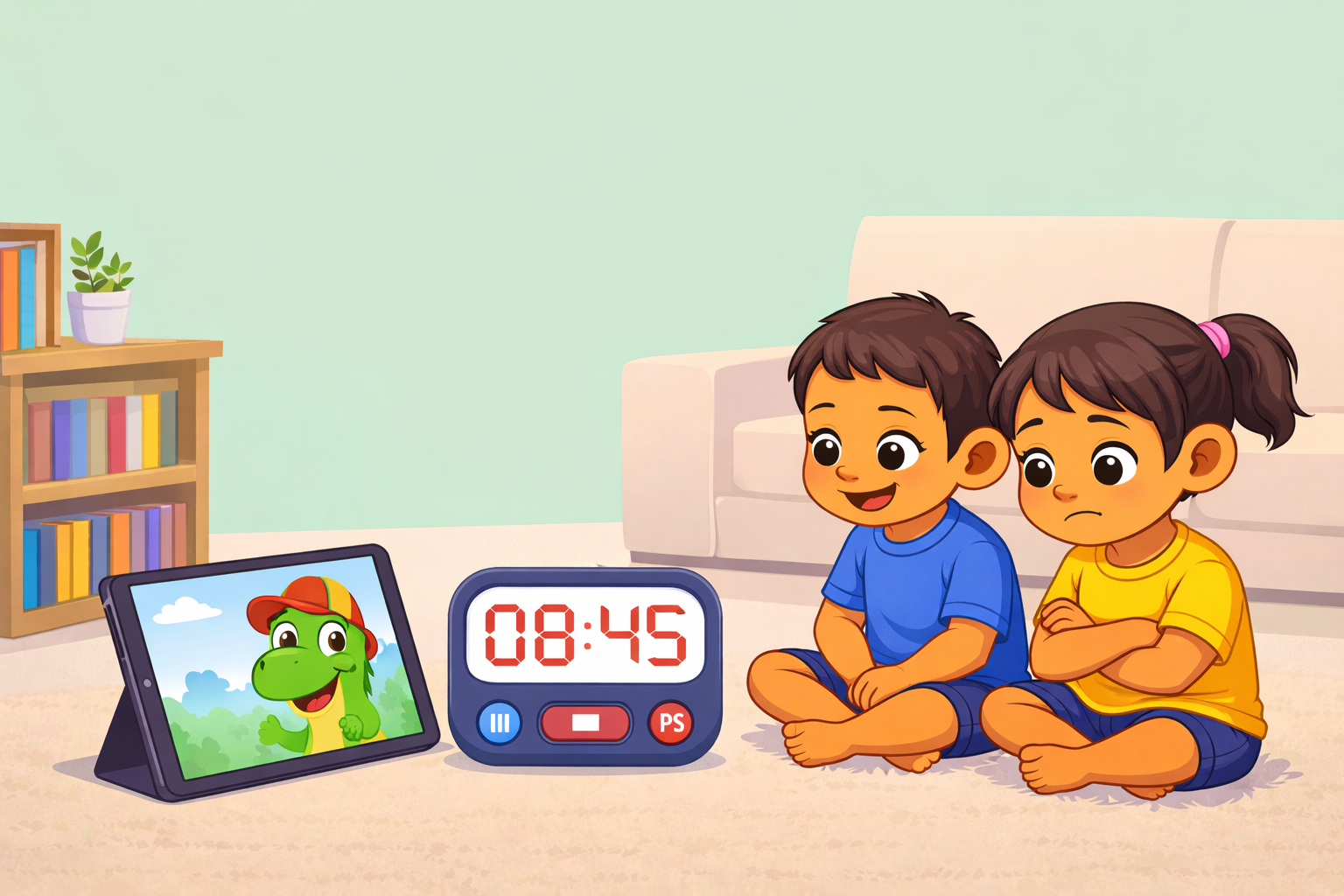
Shared devices can quickly become battlegrounds. Teaching turn-taking around technology requires structure and emotional support.
Families often find success with:
Visual timers or schedules
Clear start-and-end signals
Advance warnings before transitions
Calm enforcement without debate
These strategies support smoother transitions and pair naturally with Helping Kids Transition Away from Screens Peacefully, where predictability reduces emotional escalation.
Supporting Emotional Skills When Envy Shows Up
Tech envy offers a valuable chance to teach emotional skills. Instead of rushing to “fix” the situation, parents can help children name and manage their feelings.
Key skills to reinforce include:
Naming jealousy or disappointment
Expressing frustration with words
Practicing patience and waiting
Recognizing others’ needs
These moments build empathy and self-awareness — skills that extend far beyond screen time and into everyday sibling relationships.
Balancing Individual Needs With Family Harmony
Some children genuinely need more downtime, stimulation, or structure than others. Honoring these differences without fueling envy takes intentional communication.
Helpful framing includes:
Explaining that needs vary, not value
Emphasizing family balance over individual comparison
Reassuring kids that everyone’s needs matter
This balance echoes themes in Social Skills in a Screened World: Helping Kids Stay Empathic, where understanding others’ perspectives strengthens relationships.
Creating Screen-Free Moments That Level the Field
One of the most effective ways to reduce tech envy is to remove technology from the equation entirely — at least some of the time.
Screen-free moments can:
Reduce comparisons instantly
Encourage cooperative play
Shift focus toward connection
Create shared positive experiences
Modeling Calm and Fairness as a Parent
Children closely watch how adults respond during moments of conflict. When parents stay calm, fair, and consistent, children learn how to handle disappointment and envy themselves.
Effective modeling includes:
Staying neutral during disputes
Avoiding reactive decisions
Explaining choices calmly
Holding boundaries with empathy
When parents model emotional regulation, siblings feel safer — even when they don’t like the outcome.
Turning Tech Envy Into a Learning Opportunity
Tech envy doesn’t mean something is going wrong. It means children are learning about fairness, patience, and self-regulation in real time.
Over time, families who approach tech envy thoughtfully often notice:
Fewer power struggles
Stronger sibling empathy
Better emotional communication
More balanced tech habits
At Fuzzigram, we believe conflict can be a teacher — especially when handled with care. When parents respond to tech envy with clarity, empathy, and consistency, siblings don’t just learn how to share devices. They learn how to navigate fairness, feelings, and relationships — skills that last far beyond the screen.
This content is for educational purposes and is not a substitute for professional medical or psychological advice.