The Role of Audio Stories in Early Imagination
The Role of Audio Stories in Early Imagination
Why Imagination Needs Space to Grow
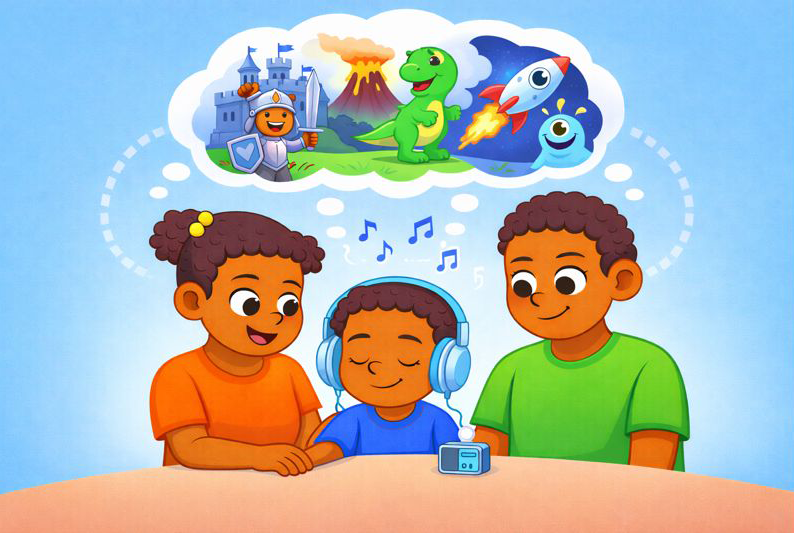
Young children’s imagination thrives in spaces that aren’t fully filled in for them. When every visual detail is provided, there’s little room left for a child’s own mental pictures to emerge. Audio stories offer something different. They invite children to create the images themselves.
Without visuals dictating what characters look like or how scenes unfold, kids actively build stories in their minds. This process strengthens imagination, creativity, and flexible thinking. Audio stories don’t rush children or overwhelm their senses — they slow things down just enough for imagination to take the lead.
In a world saturated with screens, audio stories quietly protect one of childhood’s most important skills: the ability to imagine.


How Audio Stories Engage the Brain Differently
Audio stories activate different cognitive pathways than visual media. Instead of reacting to images, children must listen, interpret, and imagine.
Listening to audio stories helps children:
Create mental imagery
Strengthen listening skills
Hold information in working memory
Follow narrative structure
Because the brain is actively filling in details, engagement stays deep without being overstimulating.
Why Early Childhood Is a Prime Window for Audio
Early childhood is a period of rapid language and imagination development. Audio stories align naturally with this stage.
They are especially powerful because:
Young children think in images and stories
Language skills are expanding quickly
Imaginative play is already active
Visual overload can interrupt creativity
Audio stories support development without competing for attention.
Audio Stories as a Bridge Between Books and Screens
For some children, sitting still with a book can be challenging, while screens may feel too intense. Audio stories sit gently in between.
They can:
Reinforce story structure without visuals
Support emerging readers
Encourage interest in books
Offer calm engagement during downtime
This makes audio a flexible storytelling format that grows with the child.
Supporting Imaginative Play Through Listening
One of the most noticeable benefits of audio stories is how often they spill into play afterward.
After listening, children may:
Act out scenes with toys
Invent new endings or characters
Combine stories with pretend play
Re-tell stories in their own words
These behaviors show imagination at work — and mirror ideas explored in Encouraging Creativity Through Digital Storytelling Tools, where storytelling fuels creative expression.
Why Audio Stories Reduce Visual Dependence
Audio stories satisfy a child’s desire for stimulation without relying on constant visuals. Over time, this helps reduce dependence on screens for entertainment.
Audio can:
Fill quiet moments without visual input
Support rest and regulation
Encourage inward focus
This balance aligns with principles in The Role of Music and Audio in Reducing Screen Dependence, where sound replaces screens as a gentler alternative.
Letting Stories Unfold Without Interruption
Unlike videos, audio stories don’t demand constant attention shifts. Children can listen while resting, drawing, or playing quietly.
This freedom allows imagination to unfold at its own pace. Kids can pause mentally, replay ideas in their heads, or drift into imaginative worlds without external pressure.
Audio stories respect a child’s natural rhythm — something visual media rarely does.
Using Audio Stories to Build Emotional Awareness
Stories aren’t just imaginative — they’re emotional. Without visuals, kids tune more closely into tone, voice, and feeling.
Audio stories help children:
Recognize emotional cues in voices
Practice empathy for characters
Explore feelings safely
These experiences support emotional growth similar to Teaching Emotional Awareness Through Media Characters, but in a quieter, less directive way.
Making Audio Stories Part of Daily Routines
Audio stories work best when they’re woven naturally into everyday life rather than treated as special events.
Families often use them:
During rest or quiet time
Before bedtime
On car rides
During calm play
Predictable routines help kids associate audio stories with comfort and creativity.
Choosing Stories That Invite Imagination
Not all audio content supports imagination equally. The best stories leave space for interpretation instead of overwhelming kids with sound effects or fast pacing.
Imagination-friendly stories often:
Use descriptive language
Allow pauses in narration
Focus on character and plot
Avoid constant noise
These qualities echo guidance found in How to Choose Podcasts and Audiobooks for Kids, where pacing and tone matter as much as topic.
Protecting Imagination in a Visual World
Imagination doesn’t disappear as kids grow — but it does need protection. Audio stories offer a simple, powerful way to preserve imaginative thinking in a visually crowded world.
Families who embrace audio storytelling often notice:
Richer pretend play
Stronger storytelling skills
Calmer media habits
Less reliance on screens
At Fuzzigram, we believe imagination is one of childhood’s greatest strengths. Audio stories don’t replace books or screens — they restore balance. By giving kids stories without pictures, we give them space to create their own.
This content is for educational purposes and is not a substitute for professional medical or psychological advice.